
Vision changes rarely arrive all at once. You might notice yourself squinting at road signs one month, then holding a menu farther out the next. Those changes usually trace back to a refractive error, which means your eye isn’t bending light to land where it should.
Nearsightedness blurs your distance vision, and farsightedness blurs your close-up vision. Which one you have comes down to the shape and length of your eye, and an eye exam measures that in a single visit.
What Refractive Errors Mean for Your Vision
Your eye works like a camera. Light enters the front of your eye, bends through the cornea and lens, then lands on the retina at the back. When it lands right on the retina, you get a sharp image. If it lands slightly in front of or behind, your vision goes soft.
The shape and length of your eye control where that light lands. A slightly longer or shorter eyeball shifts the focus point, and that shift shows up as blurry vision.
These focus problems are called refractive errors, and they include:
- Myopia, or nearsightedness
- Hyperopia, or farsightedness
- Astigmatism, where an unevenly curved cornea blurs vision at every distance
- Presbyopia, the age-related loss of near focus that usually starts in your 40s
Nearsightedness, or Myopia
With myopia, the eyeball is longer than average or the cornea curves too steeply, so light focuses just short of the retina. Close work stays sharp while the whiteboard across the room turns fuzzy.
Myopia usually appears during the school years and can continue to progress as a child’s eyes grow. Its prevalence has also been increasing rapidly around the world, which is changing the way optometrists approach children’s eye care. The goal is not only to identify myopia earlier but also to monitor how the eye is growing over time.
This matters because higher levels of myopia are associated with an increased risk of certain eye complications later in life, including retinal detachment and glaucoma. Most eye growth occurs during childhood and the teenage years and typically slows toward the end of adolescence. Because excessive eye growth cannot be reversed, early testing, regular monitoring, and treatment can help manage progression while the eyes are still developing.
Depending on a child’s needs, an optometrist may recommend myopia control options designed to slow excessive eye growth, such as specialized lenses or atropine drops.
Farsightedness, or Hyperopia
Hyperopia flips the picture. A shorter eyeball or a flatter cornea sends light to a focus point behind the retina, so reading and other close tasks may lose definition first.
Many children are born with some degree of farsightedness. Young eyes can often compensate by focusing harder, which can make the problem less obvious during everyday activities. This is one reason a child may appear to see well even when they have an underlying refractive error.
If one eye is significantly more farsighted than the other, or if the farsightedness is substantial, the extra focusing effort can sometimes contribute to an eye turning inward. A small or intermittent eye turn can also be easy for parents and teachers to miss.
Farsightedness, a significant difference in prescription between the two eyes, or eye misalignment can also contribute to amblyopia, sometimes called “lazy eye.” Amblyopia occurs when vision in one eye does not develop normally during childhood because the brain receives a clearer or more reliable image from the other eye. This can result from an eye turn, a significant difference in prescription or focus between the eyes, or a combination of both.
School vision screenings can sometimes miss these concerns because a farsighted child may still read a distance chart without difficulty. A comprehensive eye exam can look beyond how clearly a child sees at one distance and assess how their eyes focus, work together, and develop over time.
Signs to Watch For at Any Age
Refractive errors build slowly, so the symptoms blend into daily life long before anyone connects them. A few patterns tend to show up with nearsightedness:
- Squinting at faraway objects
- Sitting close to the TV or moving toward the front of a classroom
- Headaches after a long drive
- Trouble reading road signs at night
Farsightedness may announce itself slightly differently:
- Blurry vision during close tasks like reading or sewing
- Eye fatigue partway through a chapter
- Headaches after concentrated near work
- Rubbing your eyes frequently
- Skipping lines or losing your place on the page

How to Read Your Prescription Numbers
Your prescription condenses all of this into a few numbers. A plus sign (+) means correction for farsightedness, and a minus sign (-) means correction for nearsightedness.
The number after the sign measures lens strength in dioptres. For example, +1.25 is mild farsighted correction, and -1.75 sits in moderate nearsighted territory.
Bigger numbers mean stronger lenses in either direction. Once you know the sign and the size, your prescription becomes easy to follow.
How Optometrists Correct Both
Either way, correction moves the focal point back onto the retina. How you get there depends on your prescription and how you spend your day.
Glasses and Contact Lenses
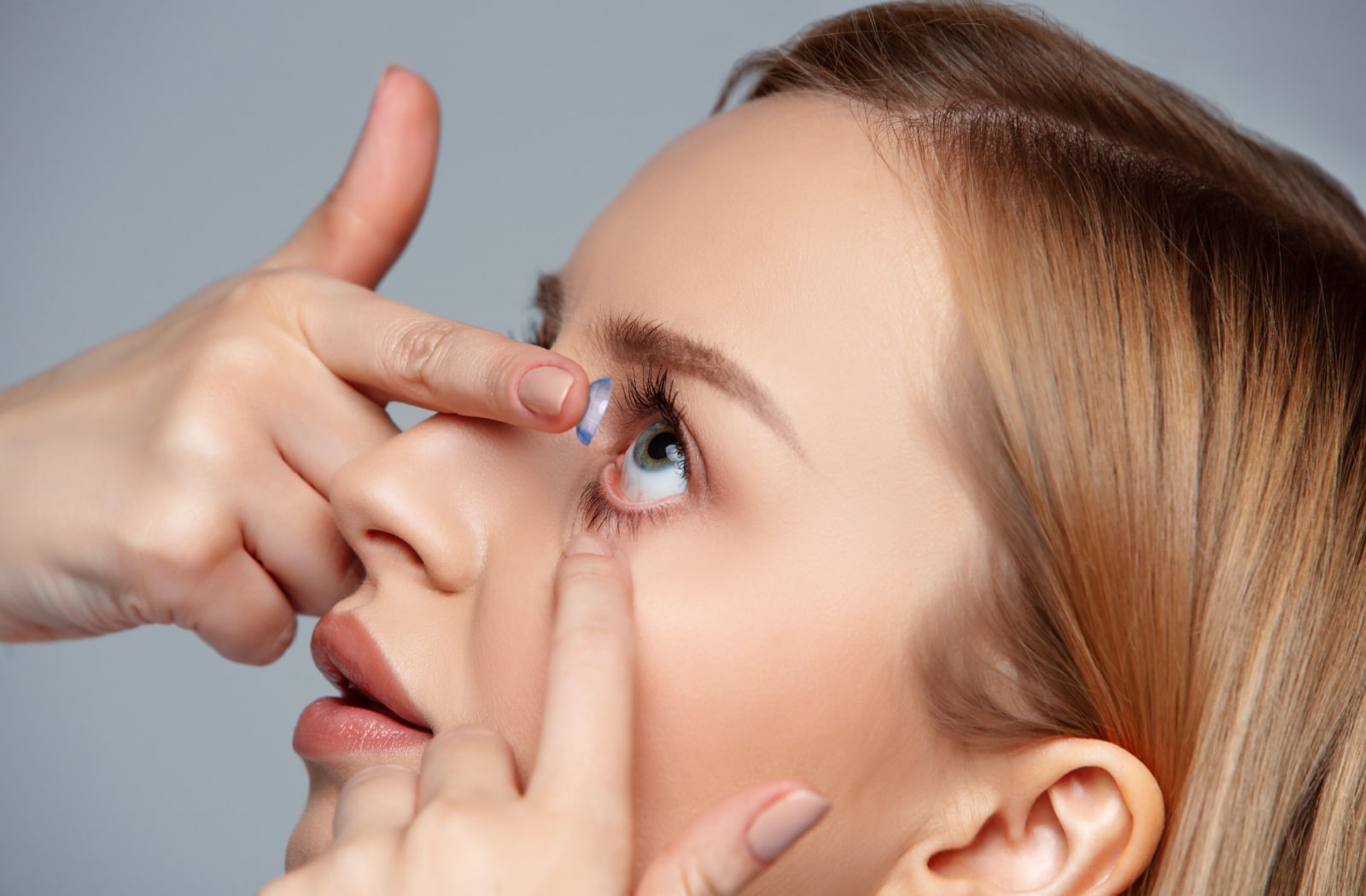
Prescription lenses bend light before it reaches your eye, so it lands right on the retina. That brings the whiteboard, the menu, or the road ahead back into focus.
Specialized lens choices can help with harder-to-fit eyes, dry eye comfort, and daily habits. The team can match a lens to how you work, play, and rest.
Vision Correction Surgery
Some adults choose surgery like LASIK or PRK to reshape the front of the eye. These options can reduce how much you rely on glasses.
Not everyone qualifies. Age, corneal thickness, eye health, and a stable prescription all factor into candidacy, and a consultation tells you where you stand.
Comprehensive Eye Exams
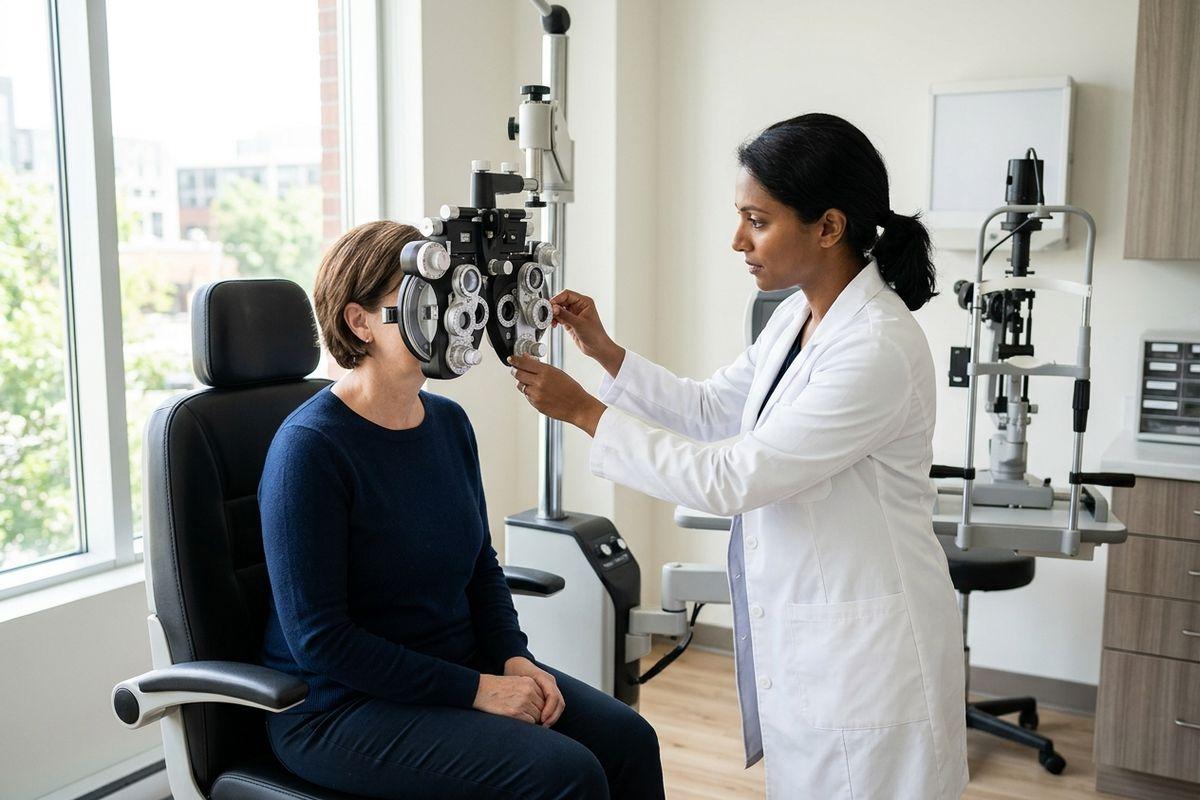
A full eye exam can identify refractive errors and other vision concerns early, even when a child does not seem to be having difficulty seeing. This is especially important because children can often compensate for certain focusing problems, and subtle changes in eye alignment or vision development may not be obvious during everyday activities or routine school screenings.
For children with myopia, regular eye exams can also help track how the eyes are growing and whether the prescription is progressing. When appropriate, early intervention and myopia control options may help slow excessive eye growth.
Regular eye exams allow an optometrist to monitor changes over time and assess more than just visual clarity. Early testing, monitoring, and treatment can be especially important during childhood and the teenage years, when most eye growth and visual development occur.
Put a Number on Your Blurry Vision
Whether you’re nearsighted or farsighted, sorting it out starts with measuring where your eyes focus. Bring in whatever you’ve noticed and let an optometrist handle the measuring.
Downtown Eye Care and The Contact Lens Department works with patients across Ottawa on first prescriptions and long-term lens care. Book your eye exam and get a clear answer.